
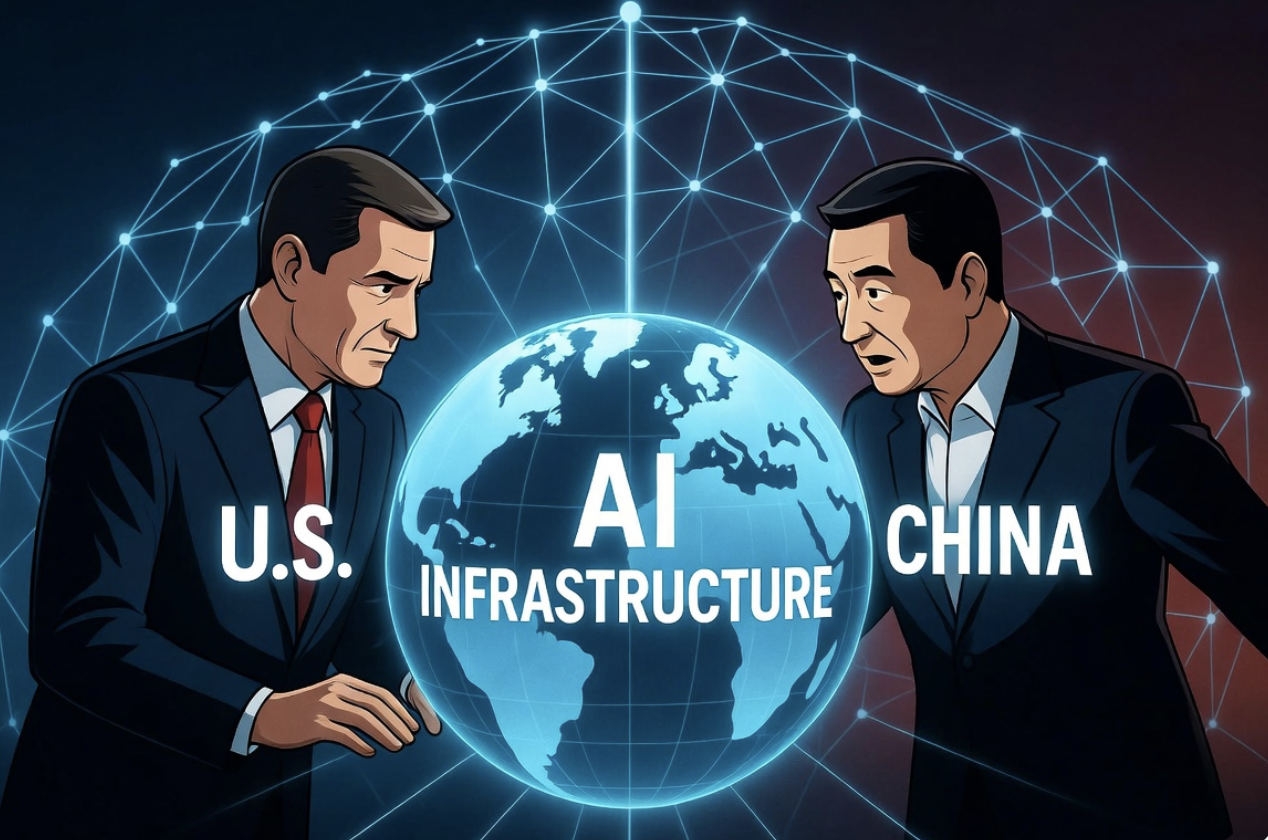
The AI infrastructure race is now the defining global contest of the decade. Nations are no longer fighting for oil or territory—they are competing for GPUs, data centers, and the energy that powers artificial intelligence. The countries that secure the most powerful compute capacity will shape the future of innovation, security, and digital influence.
The New Arms Race: Compute, Not Missiles
Just as nuclear power defined the 20th century, AI compute capacity defines modern strength. The U.S., China, and the European Union are investing heavily in supercomputers, semiconductor manufacturing, and sovereign AI models. Whoever commands the most compute will lead in automation, defense, and global technological dominance.
U.S.: Betting Big on Private Sector Might
The United States leads the AI infrastructure race through tech giants such as NVIDIA, Microsoft, Google, and Amazon. These companies are building massive AI supercomputers capable of training trillion-parameter models.
However, this dominance depends heavily on private enterprise, creating pressure for stronger public investment. Even OpenAI’s $1.4 trillion proposal to the White House shows that sustainable AI growth requires national-level support.
Key Developments:
-
The CHIPS and Science Act boosts domestic semiconductor production.
-
OpenAI, Anthropic, and Google DeepMind dominate model development.
-
Texas, Arizona, and Virginia emerge as compute and energy hubs.
-
New partnerships aim to secure U.S. compute sovereignty.
China: Building a Firewall of Silicon Sovereignty
China’s mission is clear: achieve technological independence and reduce reliance on Western chips. After the U.S. banned exports of NVIDIA and AMD AI hardware, Beijing accelerated domestic chip programs such as Huawei’s Ascend and Birente’s GPUs.
State-backed compute zones are uniting AI, energy, and data resources into a single national compute grid, reflecting China’s belief that compute independence equals national strength.
Europe: Regulation Over Acceleration
Europe trails in raw compute capacity but leads in AI regulation and sustainability. Programmes such as EuroHPC and new green data centers focus on long-term resilience and ethical AI. However, without major chip foundries or hyperscaler infrastructure, Europe risks remaining a policymaker rather than a power player.
Key Challenges and Goals:
-
Limited chip access due to global export restrictions.
-
The AI Act and strict governance slow innovation.
-
Building carbon-neutral data centers is costly but vital.
-
Partnerships with NVIDIA, AWS, and local firms aim to close the gap.
The Power Bottleneck: Energy and the Environment
AI systems require enormous energy. Training a single large model can use millions of kilowatt-hours.
This has made energy the new frontier of the AI race. Governments and companies are experimenting with AI-driven energy optimization, advanced cooling systems, and nuclear-backed compute centers to balance growth and sustainability.
Emerging Energy Strategies:
-
Microsoft and OpenAI explore AI-powered efficiency systems.
-
Nuclear microreactors may soon fuel hyperscale data centres.
-
Startups design carbon-aware AI operations to reduce grid strain.
What Comes Next
The AI infrastructure race is just beginning. The real winners will not only own the fastest chips but will also control energy, supply chains, and global standards.
This is no longer about technology alone; it’s about who controls the intelligence of the future and shapes the balance of global power in the AI era.
Read Next: https://mediablizz.com/google-mixboard/